

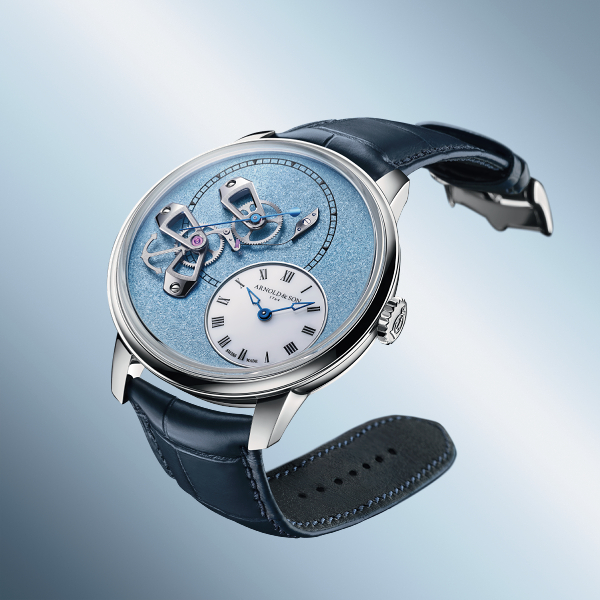
Where we’re currently at in horology, the concept of an exposed calibre is no longer a novelty. Sapphire casebacks are many in one. Openworked watches carve their dials out to flaunt glimpses of what lies beneath. Then there are the skeletonised pieces, designed to invite the eye to admire every tick and rotation, every spin of the balance wheel.
What is uncommon, however, is a watch that can display the inner workings of its movement without succumbing to the usual convention of hacking away at a dial. Arnold & Son’s DSTB collection — that is short for “Dial-Side True Beat” — manages to break away from that entirely. The brand’s solution is elegant in its simplicity: why not bring the mechanism above the dial instead of hiding it beneath?
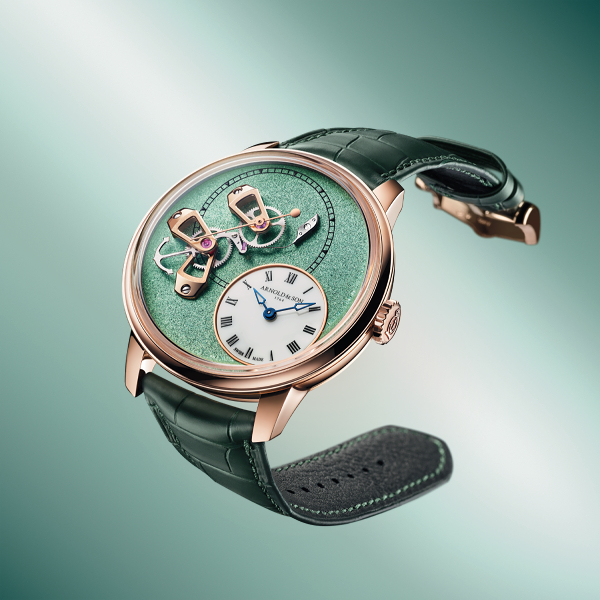
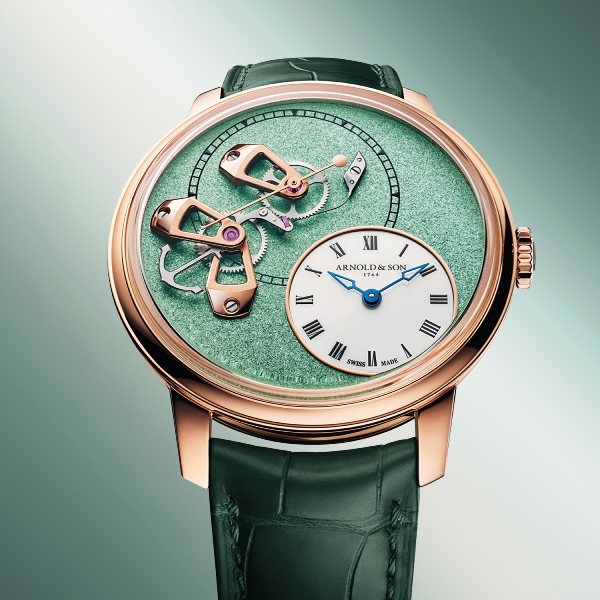
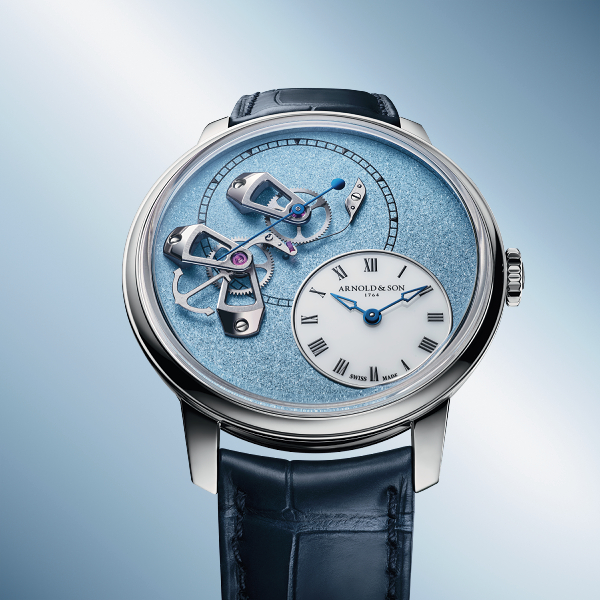
But like all things Arnold & Son, it’s done so deliberately. Only one part of its automatic A&S6203 calibre is exposed — the true-beat seconds mechanism. It functions as a jumping seconds mechanism, beating precisely at one oscillation per second. Each time the Arnold & Son anchor swings, it acts as a counterweight in this quasi-escapement, tirelessly orchestrating the seconds hand as it jogs along its track.
The complication is inspired by the titular founder, John Arnold’s 18th-century marine chronometers, which were once supplied to the Royal Navy. It serves almost as a tribute to the man behind some of the most accurate marine chronometers of the 18th century and a contributor to the modern chronometer we know today.
(ARNOLD AND SON)
On the other side of this “globe” lies a Roman numeral sub-dial for hours and minutes crafted in white opal. It’s positioned off-
Read more from original article, all rights reserved Inside the Arnold & Son DSTB 42: Dial-Side True-Beat Seconds Explained
Leave a Reply