

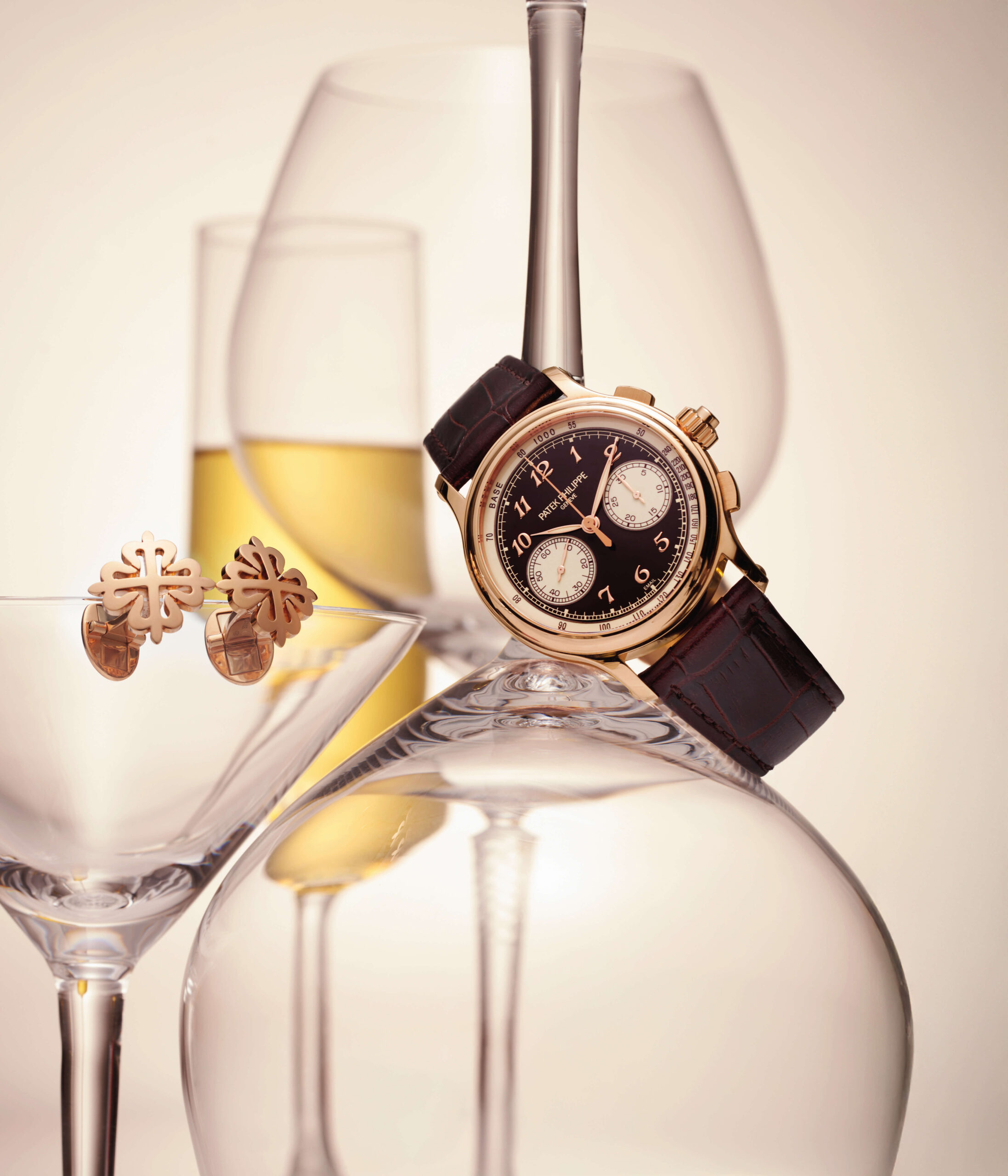
Among the many emblematic complications in haute horlogerie, the split‐seconds chronograph has always held a heightened resonance. It is all at once analytical and poetic: a mechanism created to separate moments that unfold too quickly for the eye, yet dependent on a delicacy of construction that borders on the improbable. Patek Philippe has long treated the split‐seconds not as a technical novelty but as a demonstration of its deepest convictions about watchmaking. The Geneva firm’s finest rattrapante watches express a philosophy of clarity, restraint, and uncompromising craft. From the experimental wristwatch of 1923 to today’s Ref. 5370 split‐ seconds chronograph and the new quadruple complication Ref. 5308, the rattrapante has become one of the clearest through‐ lines in the manufacture’s story.
In the words that follow, we are about explore that very line. It begins with timepiece no. 124.824, sometimes considered the first split‐seconds chronograph made specifically for the wrist. It then traces the rise of the perpetual calendar chronograph with the Ref. 1518, and the parallel evolution of early split‐seconds wristwatches such as the references 1436 and 1563. From there, it moves through the present era of in-house chronograph design, the ultra-thin CHR 27-525 PS, the patent-laden CH 29-535 PS family, and the way these ideas reach maturity in the Ref. 5370 (read the Cover Watch story), Ref. 5204, Ref. 5373 and the Ref. 5308. The aim is to tell the story of the split-seconds chronograph through key references.
1923: THE VERY FIRST WRIST-WORN RATTRAPANTE
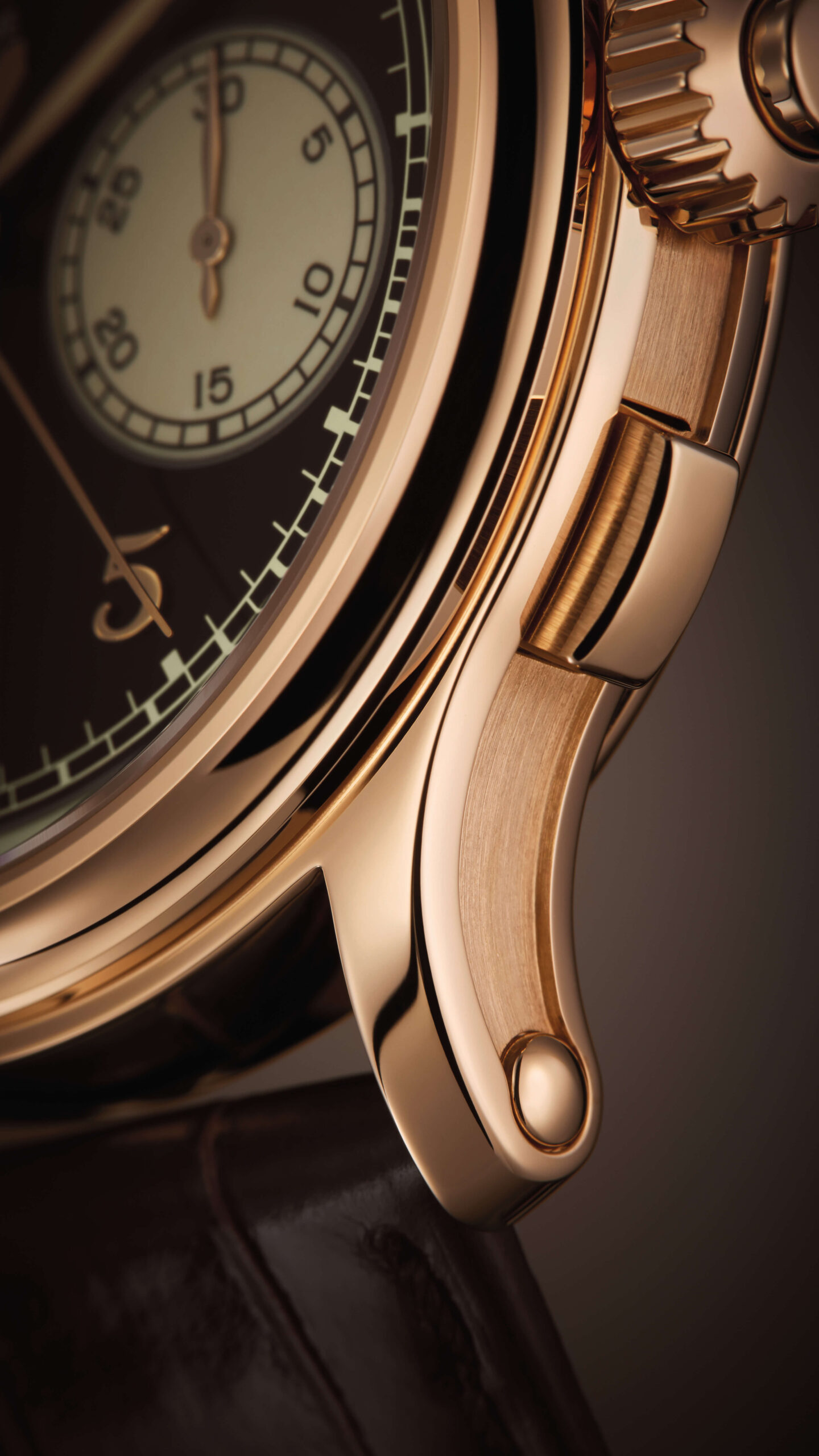
When collectors and scholars discuss the 1923 origins of the Patek Philippe split-seconds wristwatch, they almost always begin with one number rather than a reference: 124.824. The movement within, cased in a 33mm yellow-gold “officer” style wristwatch with an enamel dial and a 60-minute counter, is widely regarded as Patek Philippe’s earliest split-seconds chronograph designed for the wrist.
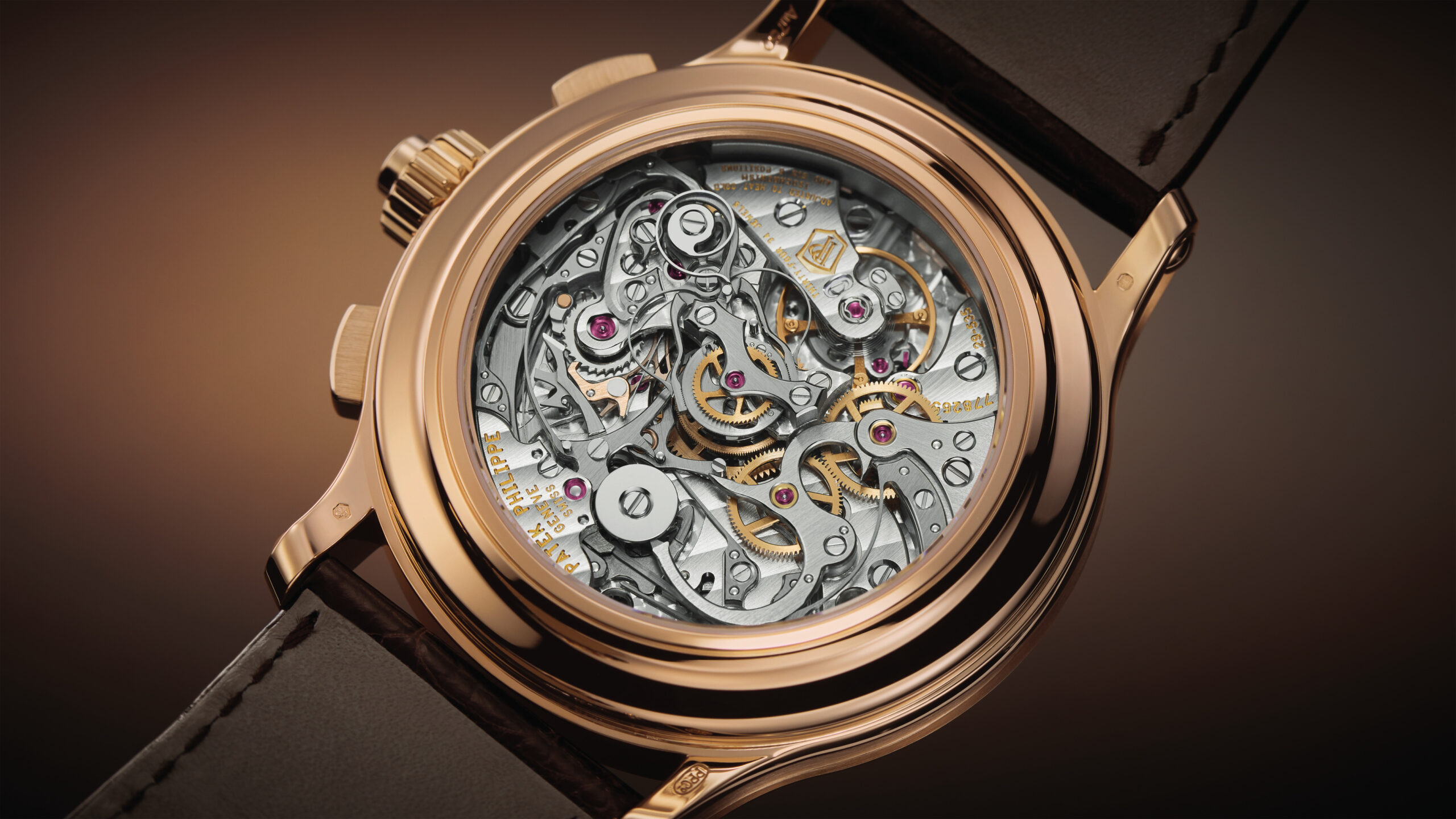
Mechanically, the challenge of building a rattrapante has always been twofold. First, it doubles the functional burden on the chronograph train by adding a second central chronograph second hand and a split-seconds wheel that must be clamped and released on command. Second, it forces the watchmaker to manage energy and friction in a system that is already parasitic by nature, since the typical chronograph draws power from the going train as soon as it is engaged.
In a pocket watch, the split-seconds mechanism has room to breathe. Levers can be long and gently curved, clamps can be generous, and tolerances can be marginally more forgiving. In a 33mm wristwatch of the early 1920s, the constraints are brutal. The movement in no. 124.824 had to remain extremely thin while accommodating twin column wheels, a layered central chronograph staff, a split-seconds heart and clamp, and a rare 60-minute counter that required more complex chronograph gearing than the usual 30-minute register.
“The message is clear: from the outset, Patek Philippe saw the rattrapante as a field for long-term exploration rather than a passing technical display”
The watch uses a single-button system with the primary chronograph functions controlled through the crown and a separate split-seconds pusher above. The start, stop and reset of the main chronograph are governed by one column wheel, while the split-seconds lever and clamp are controlled by the second. The clamp must grip the split-seconds wheel with enough force to halt it instantly, yet release it without leaving marks on the teeth or disturbing the meshing with the heart cam. Achieving that behaviour in such a compact calibre at the time required tolerances that would have been demanding even in a much larger movement.
What makes 124.824 more than a historical curiosity is the way Patek Philippe subsequently treated it. Nearly a century later, when the manufacture introduced the Ref. 5959 in 2005, its calibre CHR 27-525 PS was explicitly based on the architecture of the 1923 movement, scaled and updated but recognisably descended from the same idea. The message is clear: from the outset, Patek Philippe saw the rattrapante as a field for long-term exploration rather than a passing technical display.
1518: THE PERPETUAL CALENDAR CHRONOGRAPH AS A PATEK PHILIPPE LANGUAGE
If the 1923 wristwatch established Patek Philippe’s ambition in split-seconds chronographs, the Ref. 1518 defined another of the manufacture’s enduring signatures: the serially produced perpetual calendar chronograph. Approximately 281 examples of Ref. 1518 were produced, with the majority encased in yellow gold, while approximately 20% were cased in pink gold. Scholarship has shown that during the reference’s 14-year production run, a total of only four are publicly known to have been completed and exist today in stainless steel. The earliest instance of this quartet was offered by Phillips recently at its Watches: Decade One (2015–2025) sale on November 8 in Geneva, where, this rarer- than-hen’s-teeth of a timepiece, fetched an unfathomable CHF 14,190,000.
Launched in 1941, Ref. 1518 is widely recognised as the first wristwatch to combine a chronograph with a perpetual calendar in regular production. Its movement was based on a Valjoux 23 chronograph ébauche that Patek Philippe reworked extensively, along with a Victorin Piguet perpetual calendar module, and elevated the finishing to a level expected of a Genevois grand complication.
The watch’s true achievement, however, lies as much on the dial as in the calibre. The 1518 established a visual and functional template that Patek Philippe would revisit for decades: twin chronograph registers at three and nine o’clock, a moonphase and date at six, and twin windows for day and month at twelve.
The calendar works are built around a 48-month cam and a set of levers and jumpers that accumulate energy over the course of the day and release it in an instantaneous change at midnight. For the wearer, the effect is a clean, legible display that hides the complexity of the underlying mechanism.
This reference set the rhythm for an unbroken chain of perpetual calendar chronographs: the 2499, 3970, 5970 and, in the fully in-house era, the 5270 and 5204. Within this family, the 5204 will later become particularly important, because it brings the split-seconds mechanism back into a genre that the 1518 first defined.
EARLY WRIST-WORN RATTRAPANTES: 1436, 1563 AND THE IDEA OF A SERIALLY PRODUCED SPLIT-SECOND CHRONOGRAPH
While the 1518 and its successors pursued the marriage of calendar and chronograph, Patek Philippe also continued to refine the pure split-seconds wristwatch in parallel. But before the split- seconds chronograph became a r
Read more from original article, all rights reserved A Century in Split Seconds: Patek Philippe’s Chronograph Legacy
Leave a Reply