
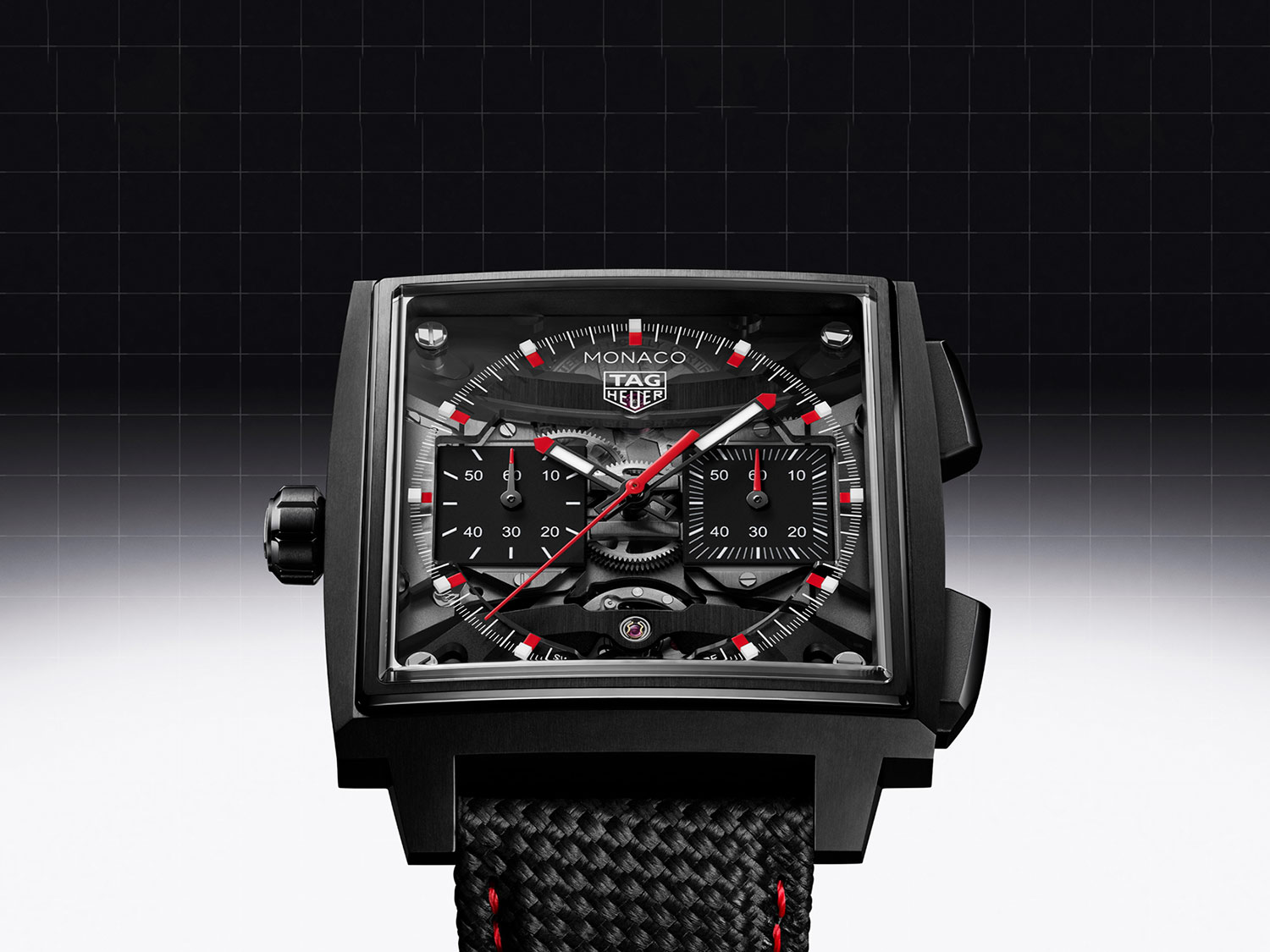
In a year celebrating the inseparable relationship between the Swiss luxury watchmaker and the chronograph, the moment has arrived for the Maison to reimagine this complication in a way that marks one of the most significant movements in the history of TAG Heuer.

Drawing on more than 160 years of innovation and expertise, where the chronograph runs as a red thread through TAG Heuer’s history like no other manufacturer, the TAG Heuer Monaco Evergraph stands as a pinnacle of achievement. It opens a new chapter for the Maison’s watchmaking savoir-faire, expressed through an entirely new mechanical architecture and an avant-garde interpretation of its square icon.
An Unrivalled Connection to the Chronograph
Since its founding in 1860, TAG Heuer has pioneered patented technologies that enhance the precision, durability and reliability of timekeeping instruments.
In the 1880s, under the leadership of Edouard Heuer, a series of patented innovations, including improvements to the oscillating pinion – a proprietary keyless winding system, and hermetically sealed cases – significantly enhanced the durability and reliability of Heuer timepieces. These advances were widely noted in periodicals of the time, which frequently highlighted Heuer’s expertise in stopwatches, split-seconds mechanisms and chronographs.
With Charles-Auguste Heuer, the early 20th century brought further milestones. The 1908 Sphygmometer introduced a patented pulsation scale on the dial. In 1911, the first dashboard chronograph appeared – an instrument line that later evolved into the celebrated Autavia of the 1930s. Then, in 1916, the Mikrograph became the first stopwatch accurate to 1/100th of a second, establishing a timing standard used at the world’s most prestigious sporting events.
The 1940s established the design codes of the modern wrist chronograph and saw the launch of the Seafarer, the first watch with tide indication. In the 1950s, a defining decision shaped the identity of the Maison, to focus exclusively on the production of chronograph timepieces, dedicating its expertise entirely to the complication.
The 1960s marked a pivotal new era for the Maison under the leadership of Jack Heuer, witnessing the birth of iconic models such as the TAG Heuer Autavia and the TAG Heuer Carrera. In 1966, the Microtimer achieved 1/1,000th-second precision, underscoring the brand’s commitment to high-frequency innovation.
In 1969, this momentum culminated in two major milestones: the launch of the original TAG Heuer Monaco, which redefined watch design as the first square, water-resistant automatic chronograph, and the introduction of the Calibre 11, the world’s first commercially available automatic chronograph movement.
That same year, Heuer became the first luxury brand to appear on a Formula One car with Jo Siffert, initiating a motorsport legacy that expanded with Scuderia Ferrari in 1971. This partnership gave rise to the Le Mans Centigraph timekeeping device and to iconic images of driv
Read more from original article, all rights reserved The TAG Heuer Monaco Evergraph: A Pinnacle Of Achievement
Leave a Reply